How to Estimate Motor Power and Torque for a Children’s Drift Car 2026/10/18 Learn how vehicle load, wheel size, and target speed affect power and torque estimates for low-voltage brushless hub motors in children’s drift cars. WINAMICS can support motor selection and validation.
Evaluating the WINAMICS 8.5-Inch Kart Motor for Racing Conditions 2026/10/16 Assess the WINAMICS 8.5-inch, 55 mm short-shaft kart motor for high-load racing use, including output stability, disc-brake response, fitment, and duty-cycle validation.
How to Check Chassis Fitment for an 8.5-Inch Kart Motor 2026/10/14 Learn how to assess chassis, wheel, axle and brake-layout compatibility for the WINAMICS 8.5-inch, 55 mm short-shaft brushless kart motor before purchase or modification.
How to Check Frame and Tire Compatibility for a Larger Hub Motor 2026/10/08 Learn how to assess frame clearance, mounting dimensions, and tire specifications before replacing a low-voltage electric vehicle hub motor with a larger model.
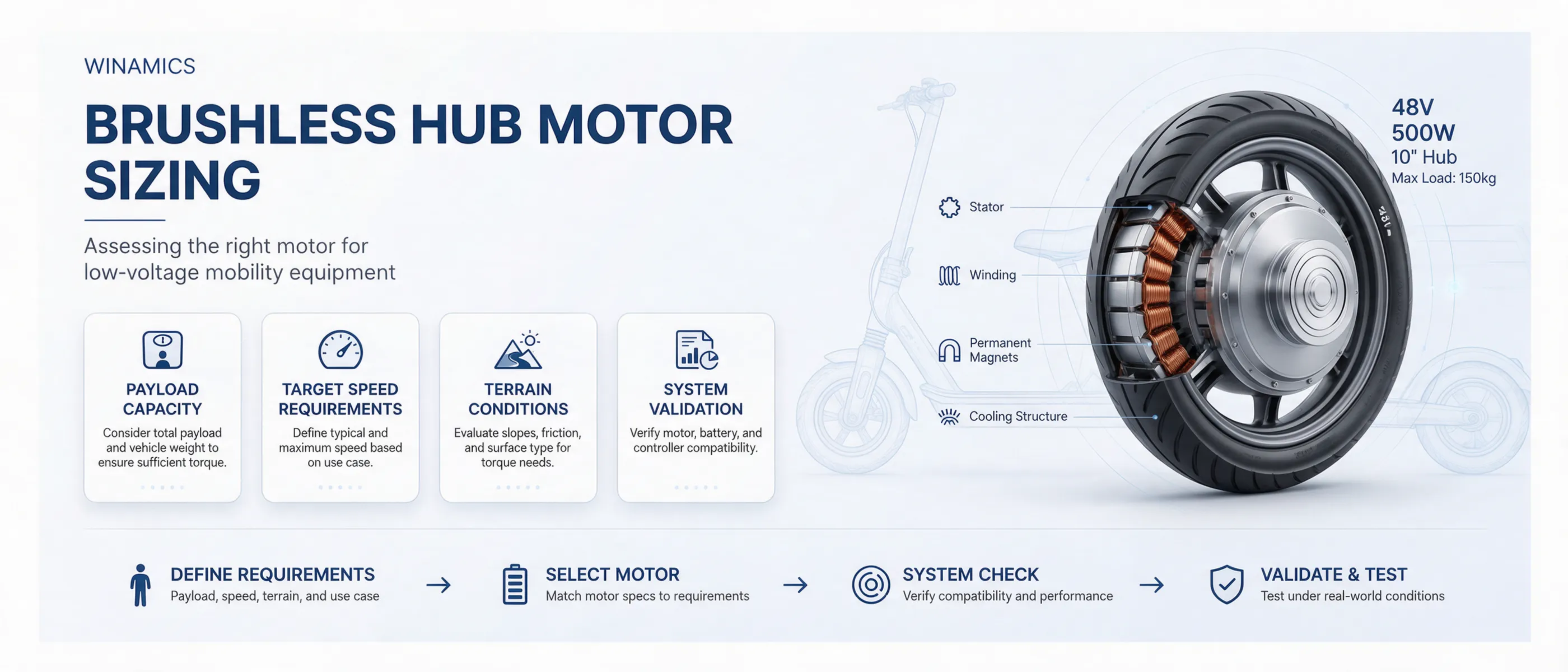
How to Size a Brushless Hub Motor for Payload, Speed and Terrain 2026/10/06 Learn how to assess brushless hub motor size for low-voltage mobility equipment using payload, target speed and operating terrain. WINAMICS outlines key checks for selecting and validating a suitable configuration.
How to Assess Brushless Hub Motor Protection for Wet, Dusty Outdoor Use 2026/10/04 Learn how to assess whether a brushless hub motor is suitable for wet, dusty outdoor use by checking protection ratings, installation conditions, and validation requirements with WINAMICS.
How to Select Brushless Hub Motor RPM for a Target Speed 2026/10/02 Learn how to estimate the required brushless hub motor speed from wheel diameter and target vehicle speed, and what operating factors to check. WINAMICS supports motor selection and testing evaluation.
How to Estimate Torque and Power for a Brushless Hub Motor 2026/09/30 Company explains how to estimate motor torque and power from a mobile device’s fully loaded weight, target speed, and maximum climbing gradient to help narrow product requirements.
How Does Brushless Hub Motor Size Affect Torque, Speed and Hill Climbing? 2026/09/28 WINAMICS explains how brushless hub motors of different sizes can differ in torque, speed and hill-climbing performance at similar voltage and rated power, and which specifications to compare before choosing.
Can Power, Speed and Torque Be Customized for Your Application? 2026/09/26 WINAMICS explains how power, speed and torque customization is evaluated, including application requirements, key performance parameters, matching considerations and validation needs.
How to Match Brushless Hub Motor Torque and Speed for Electric Material Handling Equipment 2026/09/24 WINAMICS explains how load capacity, target speed, gradeability and wheel diameter affect brushless hub motor torque and speed selection for electric material handling equipment.
How Hub Motor Speed and Torque Affect Flat-Road, Heavy-Load and Hill-Climbing Applications 2026/09/22 WINAMICS explains how rated speed and maximum torque affect brushless direct-drive hub motor selection for high-speed flat-road use, heavy-load transport and hill climbing.


.png?x-oss-process=image/resize,h_100,m_lfit/format,webp)
.png?x-oss-process=image/resize,h_100,m_lfit/format,webp)

.png?x-oss-process=image/resize,h_100,m_lfit/format,webp)