LOW-VOLTAGE POWERTRAIN SOURCING GUIDE
Sourcing brushless hub motors, motor controllers, and energy battery packs requires more than comparing quotations or individual specifications. These components operate as part of a low-voltage powertrain system, so purchasing decisions should consider their electrical compatibility, mechanical integration, intended operating conditions, validation requirements, customization details, and delivery coordination.
For B2B buyers, Shenzhen Jinhaixin Holdings recommends clarifying system requirements early and reviewing the complete sourcing process before finalizing a component selection. The following five pitfalls can help procurement, engineering, and project teams identify areas that deserve closer attention.
A hub motor, controller, and battery pack may each appear suitable when assessed separately. However, reliable sourcing depends on whether the components can work together within the application’s operating conditions and integration constraints. A structured evaluation helps buyers communicate requirements clearly and reduce uncertainty during development, customization, and production planning.
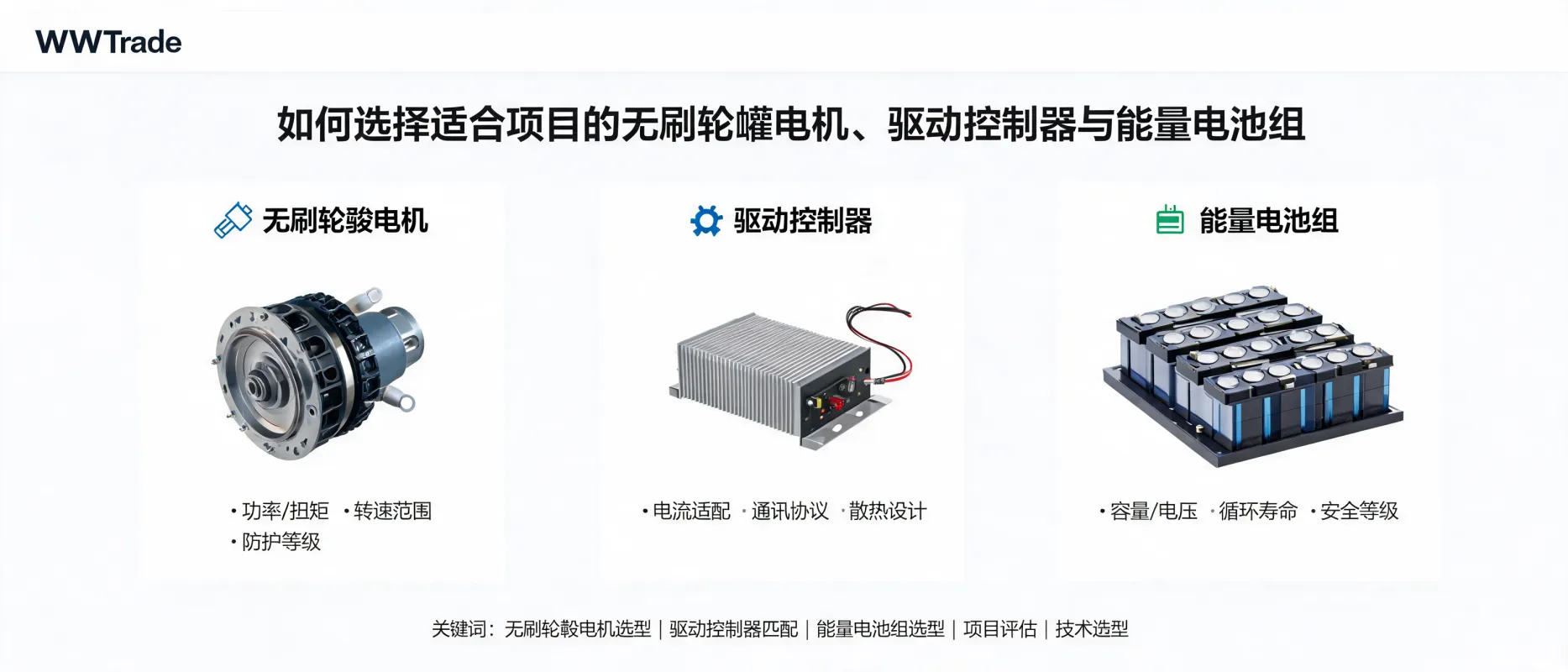
One common procurement risk is reviewing motor, controller, and battery pack parameters independently rather than as connected parts of one powertrain. A brushless hub motor’s requirements need to align with the controller’s operating capability, while the battery pack must support the overall system demand and intended use.
A clear parameter-matching discussion gives suppliers and buyers a shared basis for evaluating the proposed low-voltage powertrain configuration.
A product selection that looks appropriate on paper may still require further assessment when the actual vehicle, equipment, or operating environment is considered. Application fit is not only about the component itself; it also involves how the system will be installed, used, maintained, and integrated into the customer’s product.
| Evaluation area | Questions for the sourcing team |
|---|---|
| Installation and integration | Does the component fit the available space, mounting arrangement, and connection layout? |
| Operating conditions | What working conditions, usage patterns, and environmental factors should be communicated? |
| System interfaces | Are wiring, control, mechanical, and battery-related interfaces defined clearly enough for integration? |
| Project stage | Is the requirement for initial evaluation, prototype development, customization, or ongoing production supply? |
The more accurately the application is described, the more effectively potential component fit can be assessed.
Validation should be considered part of the sourcing process, particularly when components are being integrated into a new or modified low-voltage powertrain. Procurement teams benefit from aligning with engineering teams on what needs to be checked before a project progresses to the next stage.
Validation is most effective when it is planned early, documented clearly, and tied to the actual application rather than handled as a final procurement formality.
Customization can support different industry applications, but it also creates a communication risk when requirements are incomplete or change without clear confirmation. Details related to component configuration, interfaces, installation, appearance, packaging, or supporting documentation should be discussed in a structured way when they are relevant to the order.
Clear communication helps both sides evaluate feasibility and organize the project around a consistent set of requirements.
Delivery management is a key part of B2B component sourcing. Even after product requirements are defined, buyers should consider how order confirmation, production arrangements, quality-related communication, packaging needs, and logistics coordination fit their own project schedule.
Confirmed product scope, order quantities, customization status, expected communication milestones, packaging requirements, shipping arrangements, and the buyer’s receiving or production schedule. Early alignment does not eliminate all variables, but it gives project stakeholders a clearer framework for managing them.
Shenzhen Jinhaixin Holdings focuses on the design, development, customization, production, and sale of low-voltage powertrain products, including brushless hub motors, drive controllers, and energy battery packs. For buyers evaluating a component solution, sharing accurate application information and project requirements is an important first step toward productive technical and commercial communication.
A sourcing decision is stronger when parameter matching, application fit, validation, customization communication, and delivery management are considered together.
 Shenzhen Jinhaixin Holdings Co., Ltd
low-voltage three-electric system
brushless hub motor
drive controller
energy battery pack
Shenzhen Jinhaixin Holdings Co., Ltd
lawn mower tire replacement
lawn mower tire maintenance
heavy-duty mower tire care
slope operation tire selection
Shenzhen Jinhaixin Holdings Co., Ltd
camping trailer hub motor selection
90mm tire width hub motor
100mm dropout compatibility
camping trailer motor installation
Shenzhen Jinhaixin Holdings
custom selection
low-voltage three-electric system
sample validation
B2B procurement
Brushless hub motor
Full process solution
Motor design and development
Prototype testing and verification
Mass production delivery
Shenzhen Jinhaixin Holdings Co., Ltd
low-voltage three-electric system
brushless hub motor
drive controller
energy battery pack
Shenzhen Jinhaixin Holdings Co., Ltd
lawn mower tire replacement
lawn mower tire maintenance
heavy-duty mower tire care
slope operation tire selection
Shenzhen Jinhaixin Holdings Co., Ltd
camping trailer hub motor selection
90mm tire width hub motor
100mm dropout compatibility
camping trailer motor installation
Shenzhen Jinhaixin Holdings
custom selection
low-voltage three-electric system
sample validation
B2B procurement
Brushless hub motor
Full process solution
Motor design and development
Prototype testing and verification
Mass production delivery




.png?x-oss-process=image/resize,h_100,m_lfit/format,webp)
.png?x-oss-process=image/resize,h_100,m_lfit/format,webp)

.png?x-oss-process=image/resize,h_100,m_lfit/format,webp)