Integrating a hub motor into a robot or light electric vehicle is a system-level decision. The motor, wheel, axle structure, battery, controller and operating load need to work together—not as separate parts. WINAMICS helps equipment developers evaluate these key conditions before prototype development, so the selected drive solution can better suit the intended installation and duty cycle.
A hub motor is installed directly in the wheel assembly, making it a compact direct-drive option for many mobile machines. However, suitability depends on how the vehicle is built and used. A motor that fits the available wheel space may still be unsuitable if the required starting torque, axle loading, electrical supply or controller capability has not been considered.
For robots, electric carts, compact transport equipment and other light electric vehicles, a practical evaluation begins by defining the real operating conditions: vehicle mass, carried load, wheel diameter, desired travel speed, terrain, gradients, run time and available battery voltage. These inputs establish the basis for hub motor selection and controller matching.
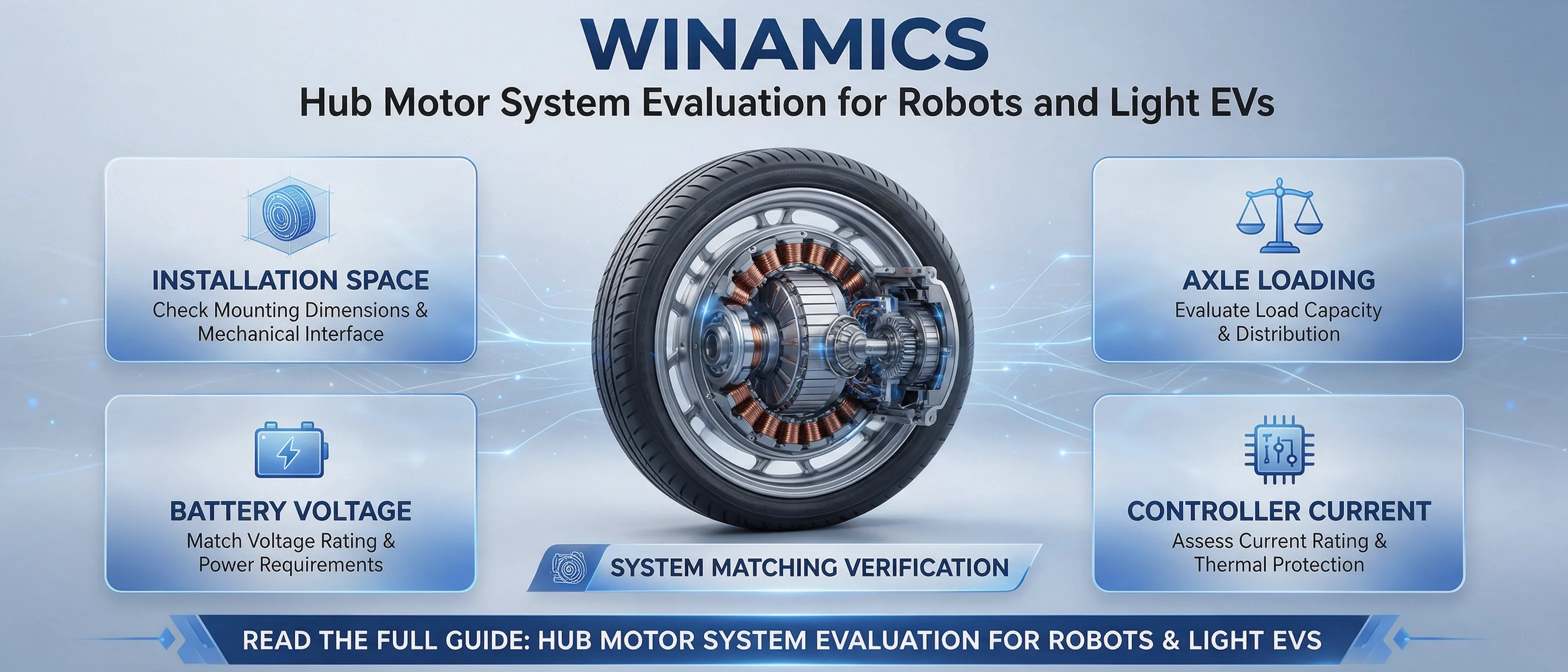
Check wheel diameter, rim or tire configuration, mounting clearance, cable routing and the surrounding chassis structure. The motor assembly must fit without interfering with steering, suspension, guards or other mechanical components.
The wheel-end structure should be evaluated for the load carried by each driven wheel, including the vehicle weight, payload distribution and loads created during acceleration, turning or uneven-ground operation.
Battery voltage affects the motor and controller configuration. The battery should support the planned operating voltage and supply current under the expected load profile, rather than only under no-load conditions.
Controller current capability influences starting, acceleration and load response. The required control method, such as forward/reverse operation, speed regulation or differential drive, should also be confirmed early.
Hub motor selection should not be based on speed or power alone. Wheel diameter changes the relationship between motor speed, vehicle speed and available driving force. A larger wheel can provide more distance per revolution, while the vehicle may require sufficient torque at the wheel to start smoothly and move under load.
| Evaluation input | Why it matters for motor matching |
|---|---|
| Vehicle and payload weight | Helps determine the driving force and starting torque needed at the wheel. |
| Target travel speed | Guides the appropriate motor speed range in relation to the selected wheel diameter. |
| Operating surface and gradient | Affects required torque, traction and the electrical demand during movement. |
| Duty cycle and continuous running time | Supports evaluation of thermal conditions during repeated or sustained operation. |
| Drive-wheel quantity and layout | Clarifies how load and traction requirements are distributed across the driven wheels. |
The hub motor, battery and controller form an electrical drive system. A suitable motor can still deliver unsatisfactory performance if the controller cannot provide the required current response or if the battery configuration does not match the intended voltage and load demand. This can appear as weak starting performance, reduced response under load, excess heat or unstable operation.
Practical principle: evaluate battery voltage, controller current, motor operating range and actual vehicle load together before finalizing a prototype configuration.
For applications requiring forward and reverse travel, variable speed, braking behavior or dual-wheel differential control, the required controller functions should be identified alongside the mechanical motor selection. This helps keep the electrical and mechanical integration aligned from the beginning.
A prototype provides the opportunity to verify the selected hub motor system in the actual equipment. Evaluation can focus on the conditions that matter most to the application rather than relying only on nominal specifications.
Clear application information makes the evaluation more efficient and helps identify a configuration that is appropriate for the equipment. When discussing a robot or light electric vehicle project with WINAMICS, the following details are useful:
WINAMICS supports hub motor evaluation for equipment developers working on electric carts, mobile robots, compact vehicles and related electric drive applications. Motor voltage, speed, torque, wheel size, axle structure and installation dimensions can be reviewed in relation to the application requirements.
Where prototype development is needed, the motor, controller and mechanical integration can be considered as a connected system—helping teams move from initial operating requirements toward practical testing and later production planning.
 Shenzhen Jinhaixin Holdings Co., Ltd low-voltage three-electric system design brushless hub motor drive controller and battery pack matching collaborative system design
Shenzhen Jinhaixin Holdings Co., Ltd brushless hub motor selection drive controller matching energy battery pack selection project evaluation
Shenzhen Jinhaixin Holdings custom brushless hub motor brushless hub motor parameters hub motor development process hub motor compatibility and operating conditions
Shenzhen Jinhaixin Holdings low-voltage three-electric system brushless hub motor drive controller energy battery pack
Shenzhen Jinhaixin Holdings Co., Ltd camping trailer hub motor selection 90mm tire width hub motor 100mm dropout compatibility camping trailer motor installation